Canvas Crafted Art | Price awaits your question.

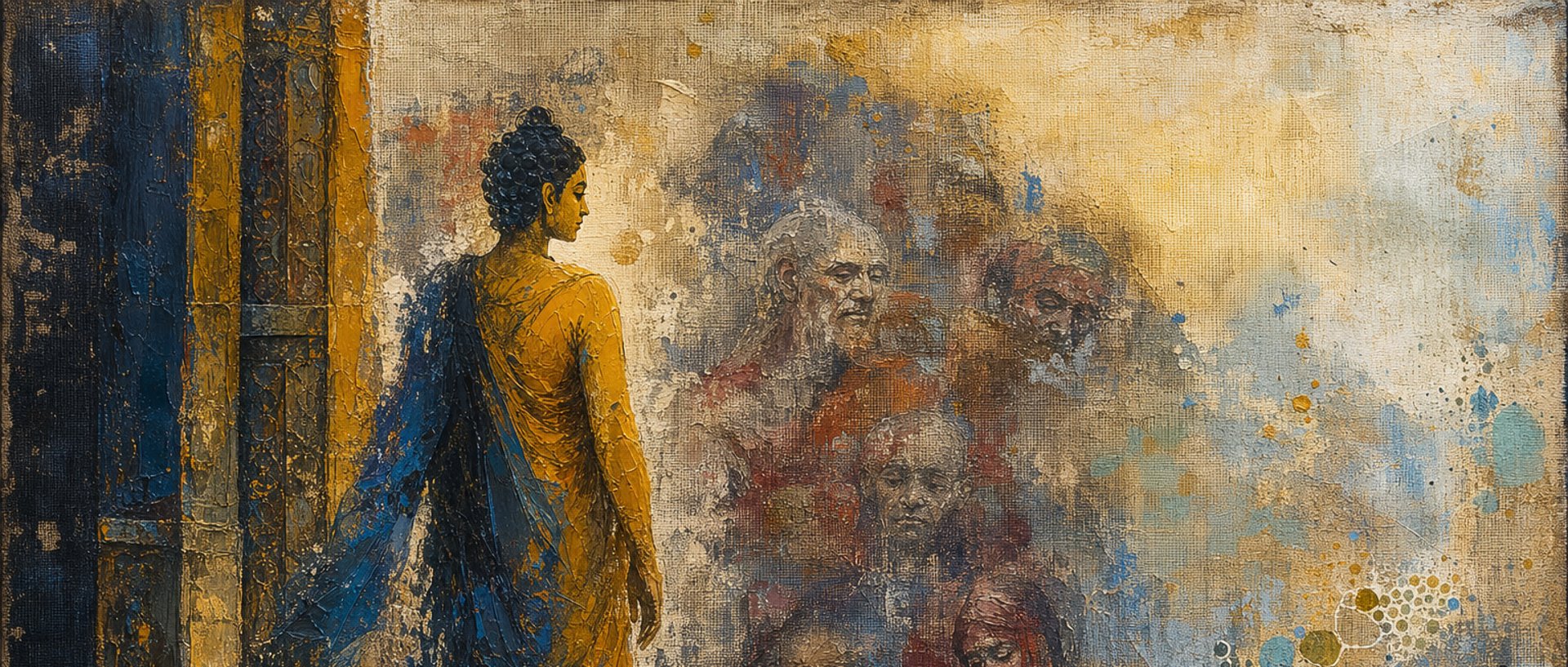
Buddha - Formless Awakening
Birth Beyond Form
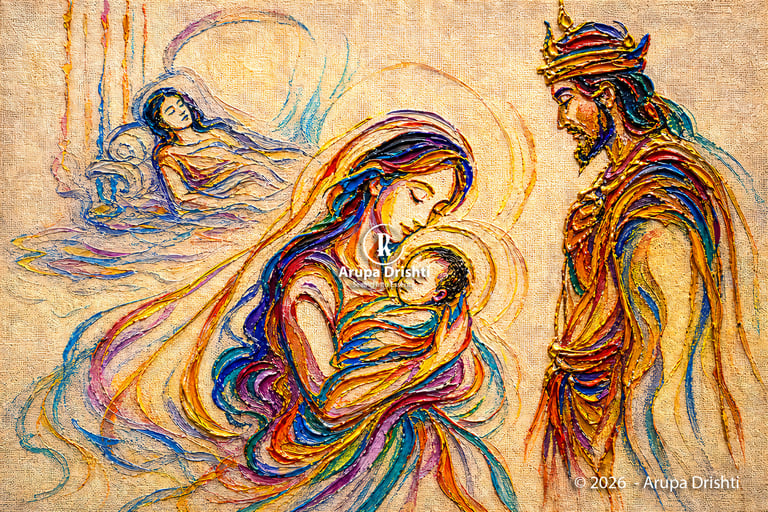
Siddhartha entered the world in Lumbini as a prince, yet his first encounter with existence was marked not by celebration, but by loss. His mother, Queen Māyā, passed away seven days after his birth — a truth that the palace tried to soften with beauty and luxury. Through the vision of Arupa Drishti, this early sorrow becomes the first whisper of the formless: a reminder that even in a life wrapped in royal comfort, impermanence breathes beneath every surface. The prophecy of greatness was only an outer reflection; the deeper truth was already shaping itself in silence.
His sheltered childhood, crafted to hide suffering, could not conceal the subtle imprint of that first absence. Surrounded by pleasure and perfection, Siddhartha lived in a world of form, yet something within him sensed its fragility. Arupa Drishti reveals these early years as a quiet preparation — the slow awakening of an inner eye that would one day see beyond appearances and recognize the formless truth woven through birth, loss, and existence itself.
The Silence Beneath the Silk
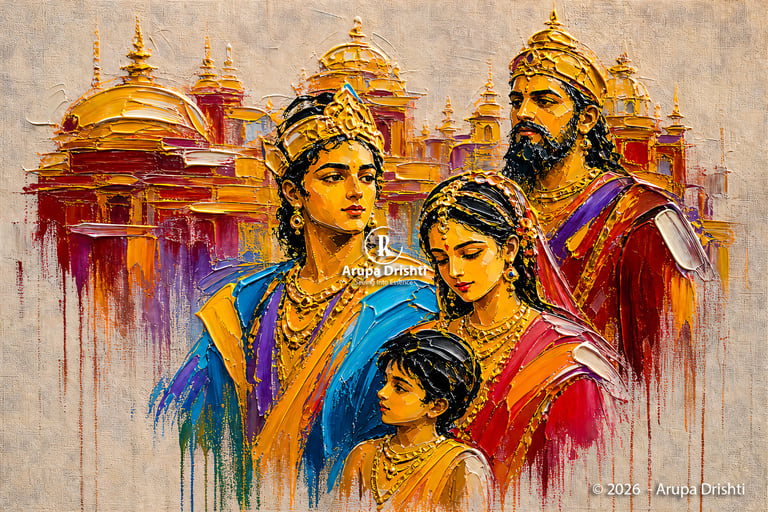
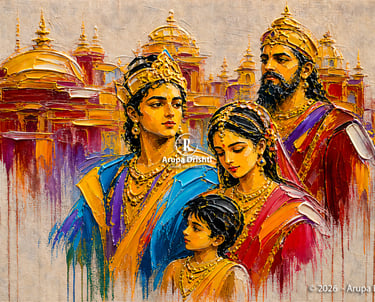
In Kapilavastu’s radiant palace, Siddhartha lived within a world shaped to appear flawless — youth, beauty, and silken abundance arranged to keep sorrow unseen. He married Yasodhara, welcomed Rahula, and moved through halls where every shadow was carefully held back. Yet through Arupa Drishti, this royal life reveals itself as the first gentle illusion, a shimmering veil over a deeper truth. Beneath celebration and comfort, an inner stillness was already rising — a quiet awareness no luxury could silence.
This life of privilege became Siddhartha’s first lesson in impermanence. Even surrounded by abundance, he sensed the quiet fading of everything he was meant to inherit. The palace revealed that even the most radiant forms bend toward change, and that love, pleasure, and identity are threads destined to dissolve.
Through Arupa Drishti, these princely years become a silent preparation — the awakening of an inner eye learning to see beyond appearances toward the formless truth that endures when all illusions fall away.
The Day Illusion Lost Its Hold
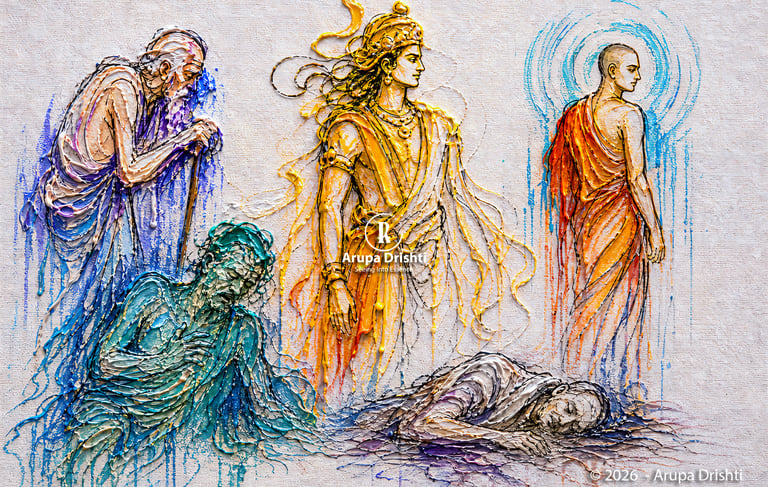
At twenty‑nine, Siddhartha stepped beyond the palace walls and encountered life without ornament: an old man, a sick man, and a dead body — three quiet truths that revealed the impermanence woven into every human breath.
Each sight shattered the illusion of permanence he had been raised to believe, showing suffering not as an anomaly but as the shared condition of all beings.
Then he saw the wandering monk, moving with a serenity untouched by fear or desire. In that simple figure, Siddhartha recognized a freedom deeper than any privilege he had known, a path that did not deny suffering but rose beyond it.
Through Arupa Drishti, the Four Sights become the moment the visible world loses its hold and truth stands uncovered: life changes, suffering is universal, and liberation begins when one stops clinging to appearances and turns inward toward the formless clarity within.
Stepping Out
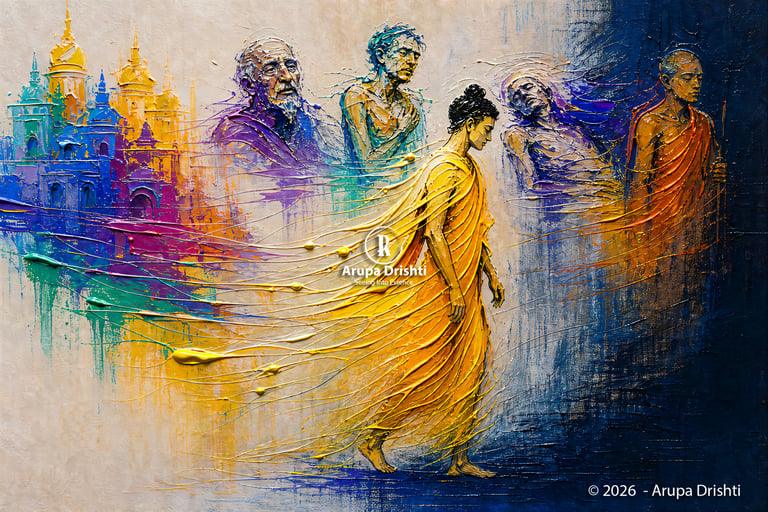
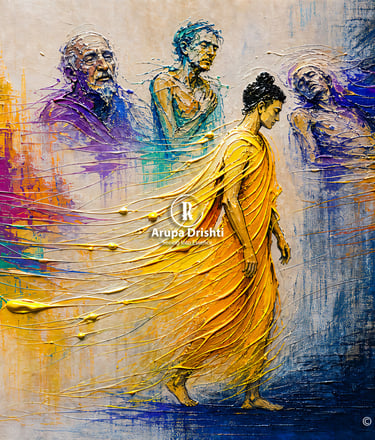
On the night Siddhartha walked toward truth, the world he knew began to unweave. His golden robes fade into exposed canvas threads, echoing an identity losing its hold. Behind him, the palace dissolves in bold strokes that taper into nothingness, mirroring the illusions of his early life.
The Four Sights hover like quiet manifestation — aging, illness, death, and the wandering monk — each rendered with pigment that thins at the edges, their fading forms reflecting how truth seeped into his heart. Soft, dissolving lines shape his face at the moment suffering becomes undeniable and awareness rises.
At the threshold, he steps into darkness painted with near‑transparent strokes, a space where certainty disappears and the search for liberation begins. This is the quiet courage of renunciation: the willingness to leave everything familiar and follow the fragile pull of truth. In this visual unraveling, the painting reveals the night his old self dissolved — and the path toward awakening opened.
Zen Vision Studio
Awakening creativity through mindful art and modern vision
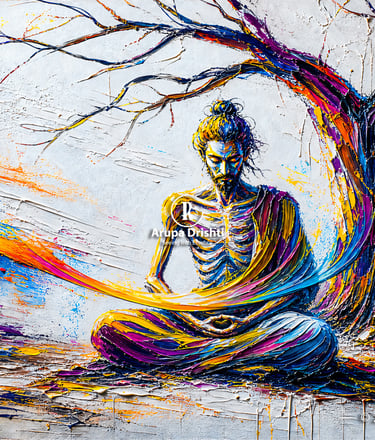
Suffering Yielded to Clarity
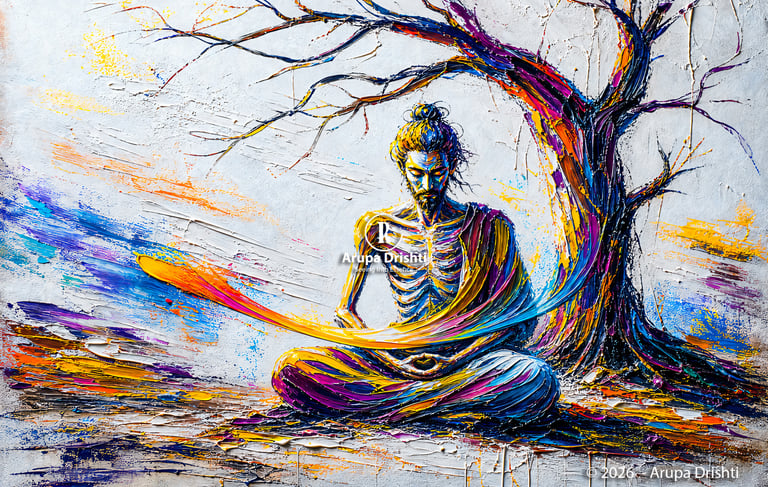
Beneath a barren tree, Siddhartha’s body becomes the quiet record of a struggle pushed to its limit. Heavy strokes at his shoulders thin into exposed canvas threads, showing how years of extreme austerity have carved him down to near‑emptiness. His ribs fade from bold lines into transparent smudges, echoing the collapse of self‑torture — a body hollowed by the belief that suffering might reveal truth.
The landscape mirrors this desolation. Dry, broken marks sink into the weave, a world stripped of nourishment and shaped by the same relentless denial draining his strength. Yet within this starkness, a single balanced stroke arcs across his posture — thick at its start, gentle at its end. It marks the inward turning, the quiet realization that truth does not live in extremes.
In that subtle shift of paint, the Middle Path emerges. Harsh strokes fade, clarity rises, and suffering loosens its grip. The painting captures the moment Siddhartha’s pursuit of liberation moves from self‑punishment to balance — the instant where awakening begins to find its center.
Moment the World Became Light
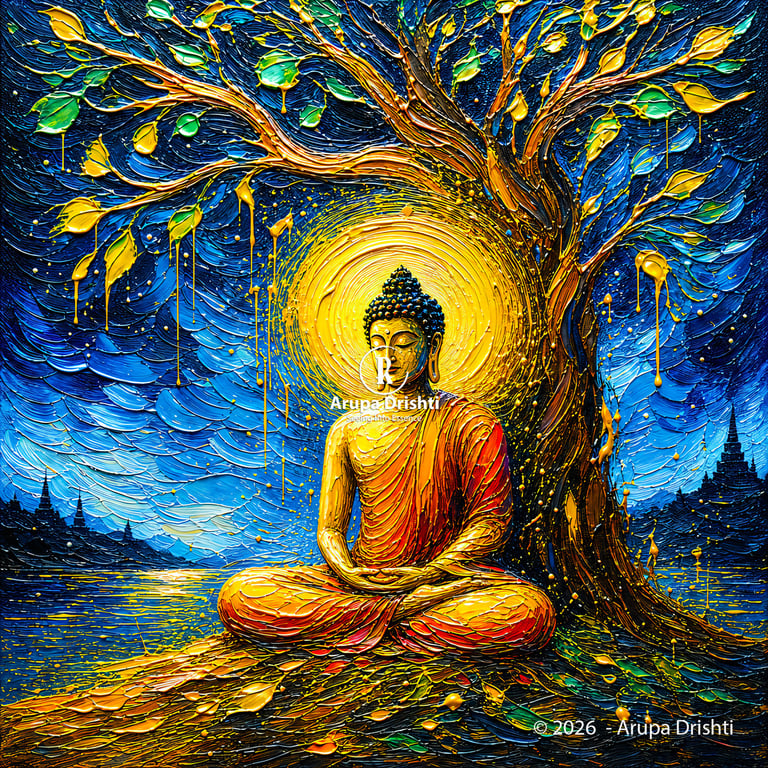
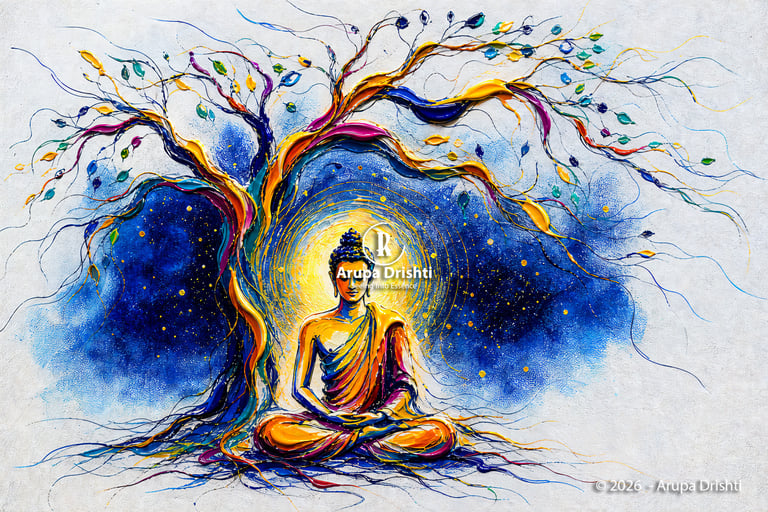
Beneath the Bodhi Tree, Siddhartha sits in perfect stillness, his form shaped by strokes that begin thick and soften into exposed canvas threads. The branches above him taper into delicate strands, merging with the raw weave like roots sinking into truth. His posture is rendered with calm, deliberate lines — pigment heavy at the crown, then fading gently down his body, symbolizing illusion dissolving into clarity.
Around him, the night sky deepens into blues that sink quickly into the canvas, a quiet vastness holding the final moments of seeking. From this darkness, a subtle halo of gold emerges — strokes that start bold and melt into shimmering transparency, capturing the first breath of awakening. The radiance does not shout; it rises softly, as though the world itself is exhaling light.
In this convergence of paint and emptiness, the instant of Enlightenment unfolds. The seeker becomes the Awakened One. Illusion thins, truth expands, and the final strokes settle into perfect stillness — the moment the world became light.
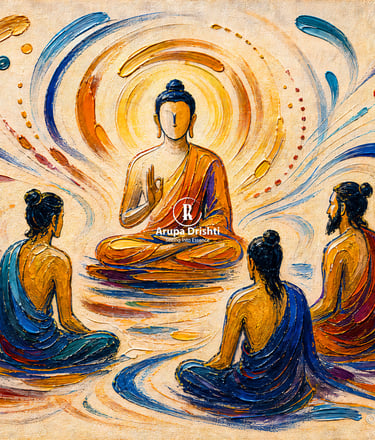
Birth of the Dharma Wheel
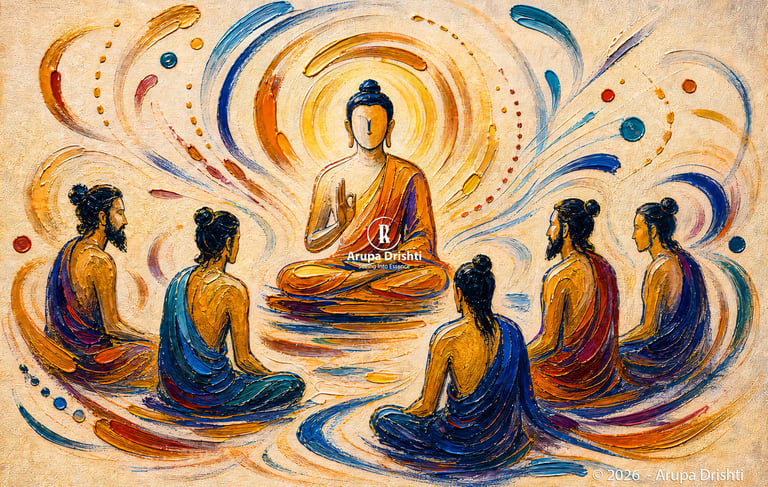
When the Wheel first turned, the world shifted in quiet circles of truth. At the center sits the newly awakened Buddha, framed by arcs of ochre and gold — strokes that begin thick and taper into exposed canvas threads, echoing wisdom spreading outward.
Around him, the five ascetics rise from strokes that start dense and dissolve into the weave, their forms softening as they lean toward the Buddha’s presence — the moment their long search finds direction.
Circular, thinning marks fill the air, evoking the Turning of the Wheel of Dharma. Subtle lines radiate outward, suggesting the Four Noble Truths and the Eightfold Path settling gently into the canvas like teachings entering human hearts.
In these layered circles of paint, the first Sangha quietly takes form. The Wheel turns, the Dharma moves, and awakening begins its luminous journey through the world.
Compassion Across Every Path
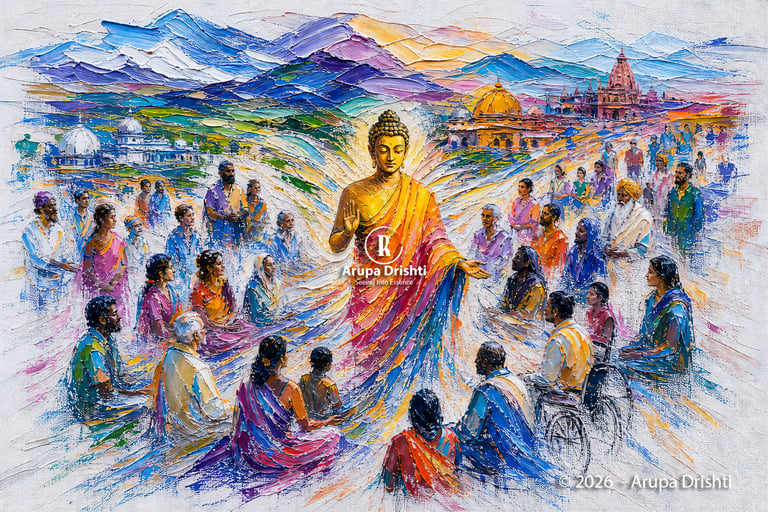
At the center, the Buddha’s robe shifts from bold, luminous strokes into soft, exposed threads—an artistic metaphor for compassion expanding outward and dissolving division. The textured canvas becomes part of the message, echoing mindfulness, openness, and gentle transformation.
Around him, figures of every caste, gender, and background gather in quiet unity. Their forms begin with dense pigment and fade into the weave, symbolizing barriers melting away through kindness and radical inclusivity. Each blended edge reinforces the teaching that liberation belongs to all.
Behind them, northern India unfolds in layered color—rich at the horizon, tapering into airy openness. Subtle strokes radiate from the Buddha’s posture, capturing mindfulness, compassion, and freedom from suffering. Heavy paint meeting exposed threads turns the scene into a living tapestry of unity and boundless humanity.
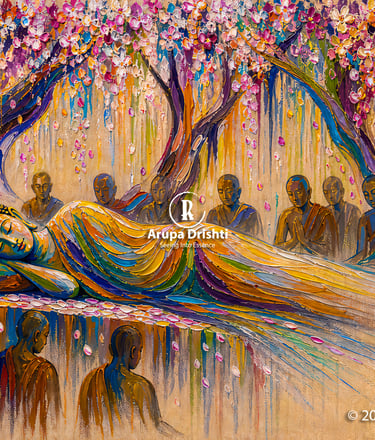
Stillness Beyond - Buddha’s Final Liberation
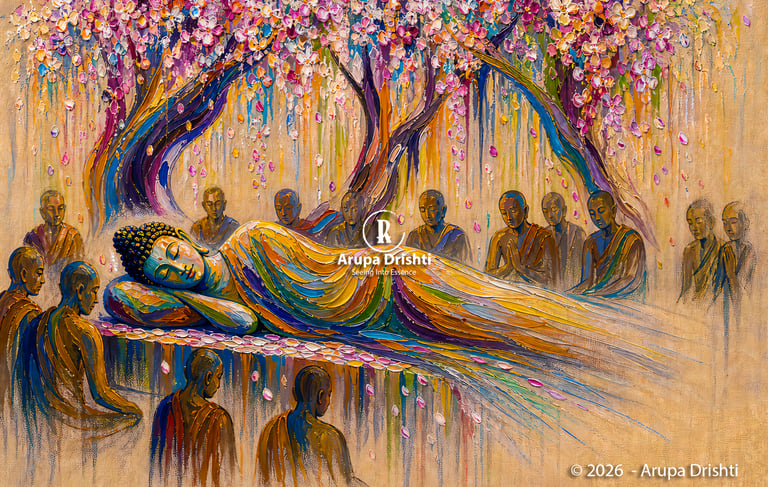
The Buddha’s final moments in Kushinagar with a serene, gallery‑ready visual language. Thick‑to‑thin brushstrokes guide the eye from presence into release, echoing the transition into Mahāparinirvāṇa. His reclining form beneath the sal trees glows with soft luminosity that gently dissolves into the raw canvas, symbolizing the quiet surrender of the cycle of rebirth.
Around him, monks gather in muted, contemplative tones. Their figures begin with dense pigment and gradually fade, reflecting grief easing into acceptance. The sal blossoms above mirror this emotional shift—painted heavy at the tips, then thinning into delicate, thread‑revealing strokes as they fall, nature itself bowing in reverent stillness.
The composition’s dissolving textures and serene palette create a powerful sense of spiritual release. Every softened edge and tapering stroke reinforces the theme of liberation beyond birth and death, making this piece a compelling focal point for any art gallery wall and a deeply SEO‑resonant portrayal of the Buddha’s final transcendence.
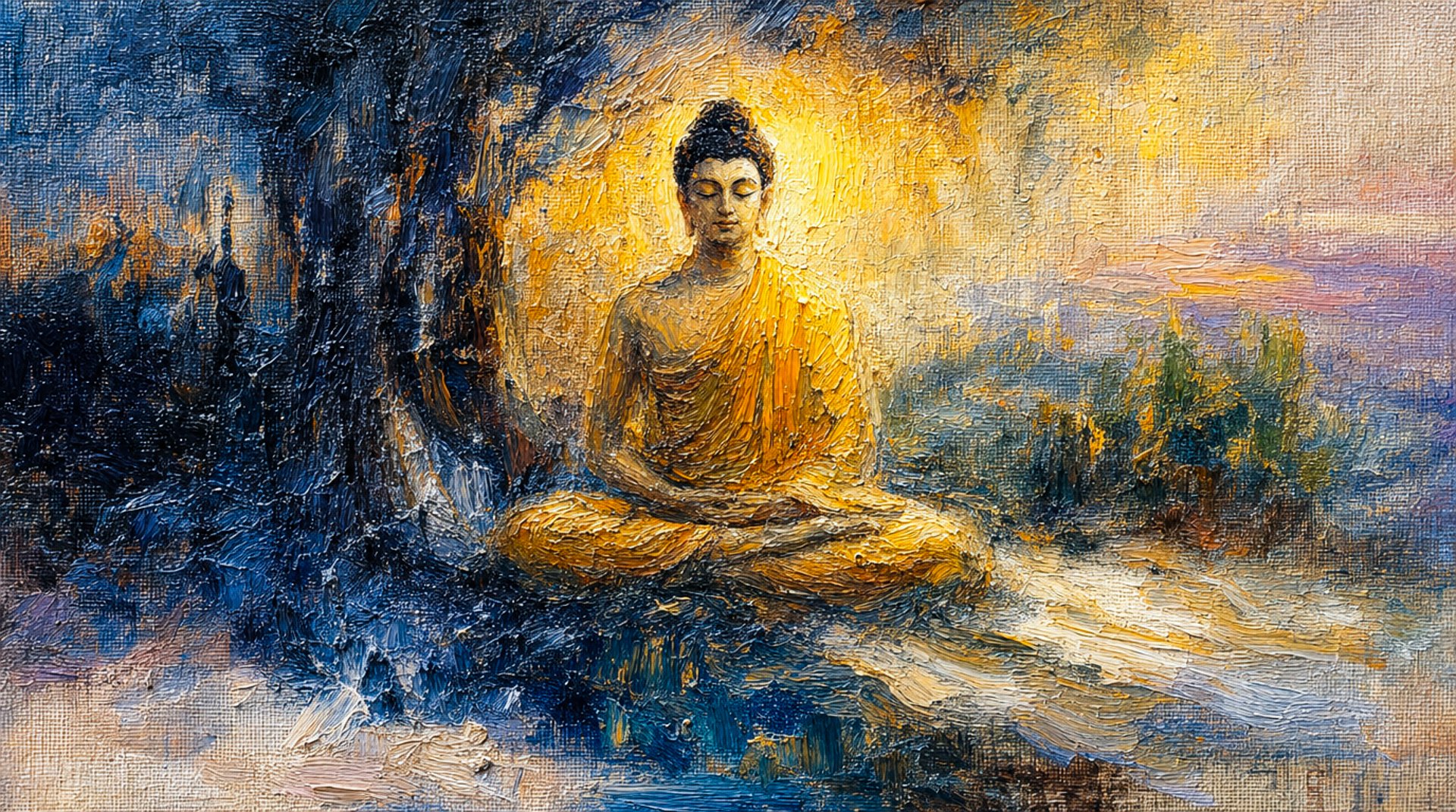
Buddha’s journey—from Lumbini’s first breath to Kushinagar’s final stillness—reveals a powerful truth: we are not the body, but the Atma, the radiant soul that travels beyond form. His awakening under the Bodhi tree exposed the illusion of suffering and opened the path to inner clarity.
As he walked through forests and kingdoms, his message remained simple and transformative: release the world, recognize the soul, awaken the eternal witness within. His life becomes a luminous guide for seekers searching for peace, purpose, and spiritual freedom, pointing toward the serene, unborn light of the Atma.ere...
J o u r n e y
C O N T A C T
L E T ' S C H A T A B O U T Y O U R
U N S E E N E L E V A T I O N
I N A M B I A N C E
E M A I L : arupa.drishti@gmail.com
C A L L : + 64 800 121 141
| © 2 0 2 6 | ARUPA DRISHTI | ALL RIGHTS RESERVED |
S P A C E S
Arupa Drishti is a haven for those who cherish the language of paint—its strokes, colours, shades, shapes, and the quiet discipline behind every creation. Each work carries a vision reaching beyond form, yet embraces the natural boundaries and limitations of creativity, whether expressed through brush, pigment, objects, or refined digital tools. Thank you for exploring these expressions of the Arupa. May every texture and tone continue to move your painter’s heart. Return anytime; the canvas will always welcome you with new and wider perspectives.
D R I S H T I — S T R O K E S O F Q U I E T
V I S I O N